

Moisture damage poses a serious threat to sensitive products during shipping and storage. For manufacturers working with electronics, pharmaceuticals and military-grade equipment, even small amounts of humidity can lead to product failure.
Desiccants provide essential protection, but only when you use the right amount. This guide walks you through the factors, formulas and methods needed to determine the correct desiccant amount for any application.
Why Accurate Desiccant Calculation Is Crucial
Accurate desiccant calculation delivers several critical benefits, including:
- Product protection: Accuracy prevents moisture-related damage during shipping and storage.
- Regulatory compliance: The right calculation helps you meet industry-specific regulations such as FDA, ISO or military governing standards.
- Cost reduction: Being accurate eliminates waste from over-calculation or under-calculation in large production runs.
- Extended shelf life: An accurate calculation maintains optimum product quality for the best possible customer experience.
The Risks of Using Too Little Desiccant
Under-calculating your desiccant needs creates serious consequences for product integrity. When packages lack sufficient moisture absorption capacity, humidity builds up inside sealed containers. This buildup causes moisture damage that leads to:
- Corrosion of metal components and connectors in electronic assemblies
- Mold and mildew that compromises pharmaceuticals, food products and organic materials
- Loss of efficacy by degrading active ingredients when exposed to humid conditions
These issues become especially critical in electronics and pharmaceuticals, where even minor moisture exposure can render products unusable or unsafe.
The Downsides of Using Too Much Desiccant
Overusing desiccant is not a better-safe-than-sorry approach. Excess desiccant has a direct impact on your bottom line. The costs add up through:
- Material expenses from purchasing more desiccant than your application requires
- Increased shipping weights and higher freight costs due to added package weight
- Cumulative waste across thousands of packages that creates substantial annual losses
A manufacturer shipping thousands of packages annually might waste money on desiccant that provides no additional protection. The added weight also increases fuel consumption across your supply chain.
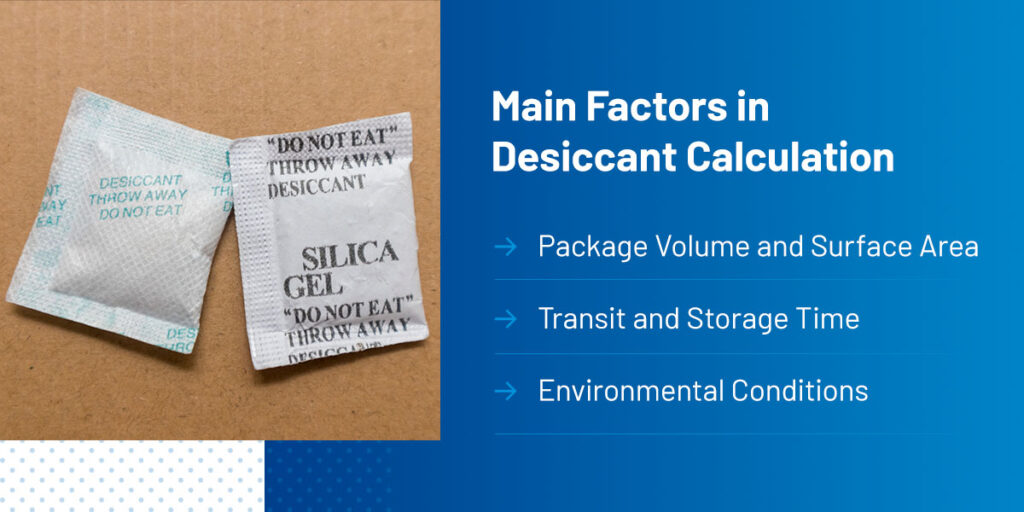
Main Factors in Desiccant Calculation
An accurate desiccant calculation requires several variables working together. Each factor influences how much moisture protection your packages need.
Package Volume and Surface Area
The amount of air in a sealed container and the surface area of the packaging material are the calculation starting points. Trapped air contains moisture that the desiccant must absorb to maintain dry conditions.
Larger containers hold more air and require more desiccant capacity. Surface area is critical because moisture can permeate through packaging materials over time. A greater surface area means more potential entry points for water vapor, increasing your total desiccant requirements.
Transit and Storage Time
The duration of shipping and storage directly impacts the risk of moisture ingress. Longer durations require more desiccant — extended exposure increases the amount of moisture that can enter through packaging materials.
A package stored for six months faces greater moisture risk than one stored for two weeks. This difference is due to increased air exchange and water vapor transmission over extended time frames.
Environmental Conditions
Humidity and temperature factors during packaging and distribution matter. The location in which a package is sealed and the conditions it travels through influence your desiccant requirements.
Consider these climate differences:
- Tropical environments: High humidity levels demand substantially more desiccant capacity.
- Arid climates: Dry conditions allow for reduced desiccant amounts.
- Temperature variations: Fluctuations affect relative humidity inside packages and change moisture absorption demands.
For example, a package sealed in Houston during the summer and shipped to Southeast Asia needs different protection than one sealed in Phoenix and shipped regionally.
Water Vapor Transmission Rate (WVTR)
WVTR measures the amount of moisture that can pass through packaging materials over time. Testing standards such as ASTM F1249 help assess long-term protection performance for different packaging materials.
Different packaging materials have different WVTRs, including:
- Foil laminates provide excellent moisture barriers with low WVTR values.
- Standard plastic films allow more moisture transmission and require additional desiccant.
Understanding your packaging material’s WVTR helps you calculate the additional desiccant needed to compensate for moisture permeation over time.
Methods for Calculating Desiccant Needs
The three main methods for calculating desiccant needs range from simple estimates to rigorous, standards-based approaches.
The Basic Formula for a Quick Estimation
A simple desiccant calculation formula provides a general estimate for desiccant requirements. The basic approach uses this calculation:
- Desiccant Weight = (Container Volume) x (Moisture Absorption Capacity) x (Initial RH – Final RH) / 100
For example, a 10-liter container sealed at 60% RH that needs to be reduced to 20% RH would require a desiccant capable of removing 40% of the moisture from that air volume. If your desiccant absorbs 10% of its weight in water, you would need roughly 4 grams of desiccant per liter, totaling 40 grams for the container.
The Military Specification Method (MIL-D-3464E)
MIL-D-3464E serves as the governing military specification for desiccant applications in defense packaging. This standard defines a desiccant Unit as a specific measure of moisture-absorption capacity.
A Unit of desiccant is the amount needed to absorb:
- 3 grams of water at 20% RH and 25° Celsius
- 6 grams of water at 40% RH and 25° Celsius
Military contractors calculate requirements based on package volume and environmental factors, then specify the number of Units needed. The official Qualified Products List provides approved desiccant products that meet this specification.
Choosing the Right Desiccant for Your Application
The type of desiccant you use matters just as much as the quantity.
Bentonite Clay vs. Silica Gel
Choosing between bentonite clay and silica gel is a common decision in desiccant selection.
Bentonite clay offers:
- Cost-effective moisture absorption for general applications
- Adequate performance in non-critical packaging
- Suitability for moderate humidity control needs
Silica gel provides:
- Superior performance in demanding applications
- Higher moisture absorption per unit weight
- Effective operation across wider temperature ranges
- Reliability and regeneration capabilities for reuse
Electronics, pharmaceuticals and military applications typically choose silica gel for its superior performance characteristics.
Understanding Desiccant Units
The desiccant Unit is the standard measurement in military and technical packaging contexts. This standardized approach helps you specify desiccant packets accurately and communicate needs to suppliers.
Units provide a consistent way to compare products from different manufacturers. A 2-Unit packet from any qualified supplier should provide equivalent moisture protection, making procurement and quality control more straightforward.
The Role of Humidity Indicator Cards
Desiccant calculation is not the end of the process. Monitoring tools called humidity indicator cards verify conditions inside packages and ensure the desiccant is working as intended. These cards change color at specific humidity levels, providing visual confirmation that moisture control remains effective.
Including indicator cards in your packages lets you verify protection during transit and storage. If cards show elevated humidity levels upon opening, you know to adjust your desiccant calculation formula for future shipments.
Get Started With Edco Supply Corporation
When you need reliable mil-spec packaging and desiccant solutions, Edco Supply Corporation delivers. As a leading supplier of military-specification packaging, we offer stock and custom packaging materials that meet rigorous government standards.
Our extensive inventory includes desiccant packets, moisture barrier bags, static shielding materials and humidity indicator cards. All products are backed by decades of expertise serving military contractors and industrial manufacturers.
Whether you’re packaging electronics, pharmaceuticals or specialized equipment, we understand the requirements your projects demand. Contact us today for a quote or call us at 646-212-0884 to discuss your specific packaging needs.