


What Are Humidity Indicator Cards?
Moisture is one of the biggest threats to the safety of shipping goods. If left unaddressed, it can damage or even ruin your product before it reaches your customers’ doorsteps.
Moisture has been a long-standing problem in supply chains and logistics, prompting the government to take action. To reduce damage to sensitive equipment during shipping, the Department of Defense had to establish strict military specifications, MIL-I-8835, that mandate the use of humidity indicator cards (HICs) in its shipments.
Explore what HICs are, how they work, how to use them for your shipments and how they can jump-start your moisture control system.
The Hidden Threat of Moisture in Shipping and Storage
Excessive moisture is a threat to most products, as there are no direct indicators of its presence. While protective measures such as void fills can help prevent physical damage, moisture is a silent killer that can damage your product during shipping and storage.
As shipments often traverse dynamic terrain, it’s also difficult to guarantee your product won’t be damaged by external factors, such as the climate. Even major shipping carriers, such as DHL, cite excessive moisture as a common shipment hazard. Fortunately, protecting your shipments from humidity is easy with a comprehensive moisture control system that starts with HICs.
How Do Humidity Indicator Cards Work?
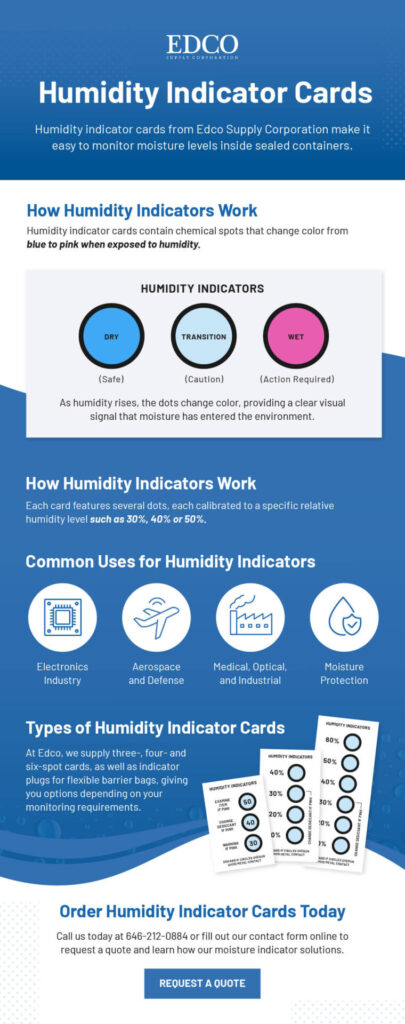
HICs are paper cards that measure relative humidity (RH) within sealed moisture-barrier bags. These cards read moisture levels through their hygroscopic impregnated spots, which attract and hold water molecules. HICs are also typically paired with desiccants to ensure RH levels remain safely controlled.
While they don’t provide an exact percentage like a hygrometer, HICs will give a reliable reading of the maximum amount of moisture your product has been exposed to. Because most HICs are reversible and reusable, they are highly cost-effective for monitoring the humidity levels in your packages.
How to Use an HIC Accurately
Since an HIC is not like a hygrometer that instantaneously reads RH, the process takes time. To use and read a cobalt-based HIC accurately, follow these steps:
- Ensure the card is dry by checking that every spot is solid blue. This step confirms that your card hasn’t been affected by air or water.
- Place it inside a moisture-barrier bag alongside your product and desiccants. To easily spot the HIC and its reading, position it at the top of your shipment.
- Heat-seal the bag and wait up to eight hours for an accurate RH reading.
- After eight hours, take a reading by looking at the highest percentage on the HIC that has shifted from blue to pink. For example, on a standard three-spot HIC, if the pink spots are between 30% and 40% but have not reached 50%, it means your RH levels have breached 40% but not yet 50%.
Cobalt-Based vs. Cobalt-Free Indicators
There are two primary formulations used to create HICs, and understanding their differences will keep you up to date with global regulations. Most HICs are purely cobalt-based and use a traditional cobalt(II) chloride formulation. These are still widely used domestically and are highly effective in monitoring moisture levels.
In other parts of the world, recent environmental and health regulations by EU organizations such as REACH have promoted the use of cobalt-free products, including HICs. To ensure you stay updated and comply with global health initiatives, here are the key differences between the two primary formulations of HICs:
- Cobalt-based HICs: This is the most common and trusted HIC formulation used domestically for military-grade equipment and consumer electronics. Its spots turn blue when the package is dry, and turn pink when moisture has entered and reached the RH threshold.
- Cobalt-free HICs: This alternative HIC formulation uses copper salts instead of cobalt, making it ideal for manufacturers shipping to EU countries. When the package is dry, its spots turn brown and slowly transition to a light blue color when exposed to moisture.
While cobalt-free HICs are the current trend, cobalt-based formulations remain the reliable and proven choice used by businesses and the military alike.

Shelf Life and Reusability
One of the greatest advantages of cobalt-based reversible HICs is their reusability, as they usually have a shelf life of three years when stored in a dry, cool area away from heat or sunlight. Thanks to the HICs’ reversible chemical reaction, they can also be reused multiple times. Do note that you should give a used card some time to turn all its spots back to blue for an accurate reading next time. You can also bake the cards or place them next to active desiccants to reverse the colors for reuse.
Types of Humidity Indicator Cards and Their Applications
Although all HIC types function similarly, they fall into distinct categories that suit different applications and industry standards. Here are four commonly used HICs used in various industries:
- Three-spot HICs: This is the standard configuration for most products, using a three-level indicator between 30% and 50%. It’s used for general industrial packaging and goods that are less sensitive to moisture, such as clothing, household supplies and plasticware.
- Four-spot HICs: This version is reserved for highly sensitive products and uses a four-level indicator between 10% and 40%. It’s typically used for consumer electronics, chips and surface mount devices (SMDs).
- Six-spot HICs: This setup is required for the most sensitive products, using a six-level indicator between 10% and 60%. With its fine-grained detail, it’s essential for high-stakes equipment such as military tools, munitions and aerospace parts.
- Indicator plugs: Indicator plugs are a specialized tool made of aluminum or plastic, generally found in two-, three- or four-spot variations. This plug creates an airtight seal in the walls of rigid containers. Its main benefit for products like pharmaceuticals is that the packaging doesn’t need to be opened to check RH levels.
Creating a Complete Moisture Control System
Using HICs will greatly help monitor RH levels. However, you’ll need to take proactive steps to manage moisture, such as a control system to protect your packages. To create an efficient defense mechanism, consider following these tips:
- Use active desiccants like silica gel packets alongside HICs.
- Ensure your packaging is sealed in an airtight moisture-barrier bag.
- Fill space with dunnage to limit moisture or mold buildup.
- Invest in nonporous packaging materials to block outside humidity.

The Premier Source for Mil-Spec Humidity Indicator Cards
Since 1954, Edco Supply Corporation has provided defense contractors and businesses with the military-spec humidity detection solutions they require. With our world-class team’s years of experience, we have established ourselves as a trusted supplier of humidity indicator cards for businesses throughout the U.S. and Canada. As we prioritize quality and reliability, you can rest assured that our HICs will help your business meet its logistics goals by providing the moisture protection your packages need.
Request a free quote today or contact us to discuss your humidity detection needs.
Linked sources:
- https://everyspec.com/MIL-SPECS/MIL-SPECS-MIL-I/MIL-I-8835A_7900/
- https://www.dhl.com/us-en/home/global-forwarding/freight-forwarding-education-center/international-shipping-hazards.html
- https://echa.europa.eu/substances-restricted-under-reach
- https://www.edcosupply.com/about/
- https://www.edcosupply.com/products-services/humidity-indicator-cards/
- https://www.edcosupply.com/request-quote/
- https://www.edcosupply.com/contact-us/