

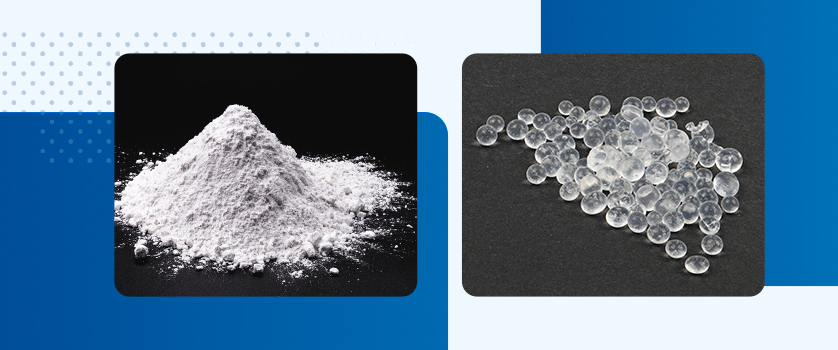
Desiccant bags are crucial in applications diverse across industries, from military and defense to food packaging and pharmaceuticals. These bags draw moisture from the surrounding air, trapping it within the structure to lower the relative humidity inside the package. They effectively prevent the adverse effects of moisture, such as rusting or mold growth, during transport and storage.
While there are multiple desiccant material options available, the two primary versions of desiccants widely used today are bentonite clay and silica gel desiccant bags. As a leading supplier of mil-spec packaging, Edco Supply Corporation provides both materials in certified MIL-D-3464E desiccant bags. Understanding their differences helps you choose the right product for your shipment or storage environment.
What Is Bentonite Clay?
Bentonite clay, derived from dried calcium bentonite, is a highly effective desiccant known for its exceptional moisture-absorbing properties. This chemically inert and noncorrosive clay efficiently draws water particles away from packaged items, trapping them in the desiccant bags.
Benefits and Considerations of Bentonite Clay
Bentonite desiccant clay stands out as one of the most cost-effective solutions for moisture protection in various industries. It performs optimally in moderately humid conditions and non-extreme temperatures.
However, if a packaged item’s temperature exceeds 120° Fahrenheit, the clay’s moisture absorption capacity may diminish. Below this temperature, the clay can typically absorb just under 30% of its own weight in water vapor. Therefore, businesses relying on desiccant clay for moisture prevention must carefully assess the environmental conditions, particularly transit temperatures, that their packages will encounter.
One of clay’s main advantages is reactivation. Bentonite clay desiccant reactivation is possible after the clay is re-dried. You can re-dry it in a circulating oven and reuse it several times while maintaining its original capacity. This makes clay a cost-effective, sustainable packaging material.
What Is Silica Gel?
Silica gel consists of numerous small granules of silicon dioxide. It is particularly useful for preventing and monitoring moisture due to its color-changing properties, which are based on the absorption of water vapor. When dry, it appears dark blue. As it absorbs moisture from its surroundings, it transitions to purple, eventually turning pink when fully saturated. This color progression allows users to easily monitor package moisture levels.
Benefits and Considerations of Silica Gel
Given that water-indicating silica gel contains cobalt chloride, businesses must prevent direct contact between the gel and package contents, especially with ingestible items. This precaution is crucial to avoid potential contamination of food and medicine. Therefore, businesses and courier services should exercise extreme caution during transport, ensuring only exceptionally secure silica gel packs are utilized.
Bentonite Clay vs. Silica Gel: Which Is Better?
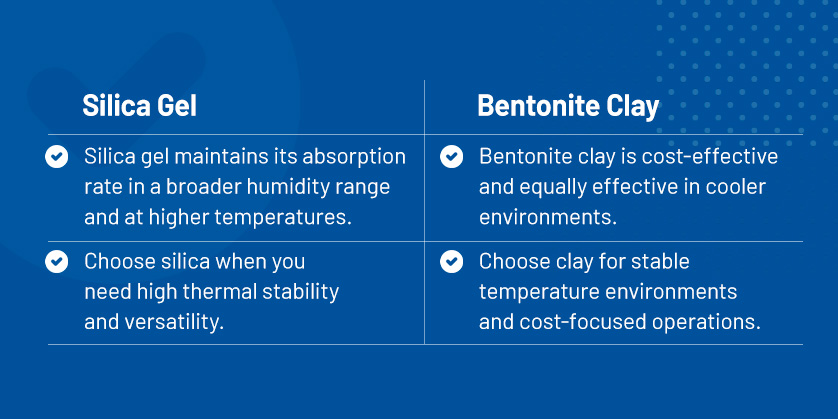
When comparing clay desiccant vs. silica gel, both materials offer reliable humidity control, but under different conditions. Silica gel maintains its absorption rate in a broader humidity range and at higher temperatures, while bentonite clay is cost-effective and equally effective in cooler environments. Choose silica when you need high thermal stability and versatility. Choose clay for stable temperature environments and cost-focused operations.
Environmental and Safety Factors
Both materials are safe and noncorrosive, but they have different environmental features. Bentonite clay is naturally occurring, biodegradable, and requires less energy to use. It’s the more eco-friendly option, especially with its reusability through re-drying.
Silica gel is synthetically manufactured and nontoxic, as well as chemically stable. Food-grade silica gel is FDA-approved for indirect contact with consumables, while clay is often used in industrial or nonfood packaging.
Industry Applications
Edco’s MIL-D-3464E desiccant bags are trusted for a wide range of industries:
- Military and defense: Use desiccant bags for protecting metal parts, weapons systems, and long-term storage equipment.
- Electronics: Desiccant bags can protect sensitive components from condensation during shipping and storage.
- Pharmaceutical: Use silica gel to maintain product integrity.
- Industrial shipping: Bentonite clay offers reliable moisture control for bulk and heavy shipments.
Cost Considerations
Bentonite is the most affordable option for packaging, but silica gel is recommended for shipments that will be exposed to higher temperatures or environmental changes. Bentonite clay weighs slightly more but costs less per unit and can be reactivated multiple times, reducing replacement costs. It’s the most cost-effective choice for large-volume shipping or long-term storage.
Absorption Speeds
Bentonite clay generally exhibits a slower absorption rate than silica gel. While bentonite clay is effective over time, it may not be the best choice for applications that demand rapid moisture removal. Silica gel is known for its faster absorption kinetics. This material can draw moisture from the air more quickly, making it suitable for highly sensitive items or in situations where humidity spikes are common and need to be controlled efficiently.
Frequently Asked Questions About Bentonite Clay and Silica Gel Desiccants
Here are some answers to frequently asked questions about silica gel and bentonite clay desiccant bags.
- Is silica gel better than dry clay? The best material depends on the packing conditions. Silica gel works better in high temperatures or when exposed to changing temperatures. Bentonite clay offers better cost control for large-scale projects or those requiring steady temperatures.
- Can you reuse desiccant bags? Both silica gel and bentonite clay have reactivation processes. However, bentonite clay has a longer reuse lifespan than silica gel.
- Which desiccant is best for high heat? Silica gel maintains its performance at much higher temperatures than bentonite clay.
- Do desiccant bags work in all temperatures? Both bentonite clay and silica gel work across a range of temperatures, but their efficiency varies. Silica gel maintains its high absorption capacity over a broader and higher temperature range. Bentonite clay performs optimally in moderate temperatures, with its capacity diminishing at higher temperatures. For extreme temperature fluctuations, silica gel is generally the more reliable choice.
- How much desiccant do I need for my package? The amount of desiccant required depends on several factors, including the package volume, type of packaging material, initial humidity level, desired final humidity level, and storage or transit duration. It’s often calculated based on unit sizes. Consulting with a packaging expert or using a desiccant calculator is recommended for precise sizing.
- How do you know when a desiccant is spent? Indicator cards or color-changing silica gel show when humidity levels get too high. Make sure to watch for moisture buildup inside packaging. If you see any moisture, replace or reactivate the desiccant.
Protect Your Products With Edco’s Mil-Spec Desiccants
For over 70 years, Edco Supply Corporation has delivered certified mil-spec desiccant solutions that meet the highest quality and reliability standards. We offer a range of bag options that comply with MIL-D-3464E Type I and II classifications. Whether you need bentonite clay, silica gel, or another desiccant option, we can help. Edco offers fast fulfillment, a large inventory, and expert support to help you choose the right product.
Call 646-212-0884 today or fill out our contact form to discuss your next packaging project.